

Real buyer insights – movement, quality, and what to expect
The Real-World Truth About the 4130 Clone in Daytona Replicas
If you have spent more than an hour researching replica watches, you already know that the Rolex Daytona is the most copied chronograph on the market. What you might not know is that the difference between a $200 fake and a $600 super clone is not the gold plating or the ceramic bezel. It is the movement. Specifically, it is the Caliber 4130 clone. Over the past few years, I have handled dozens of these watches – from cheap stock movements to the latest 1:1 clone watches that claim to be indistinguishable from the genuine article. The conclusion I have reached is simple: a great case with a poor movement is a waste of money, but a decent case with a well-executed 4130 clone is a watch you will actually enjoy wearing.
In this guide, I am not going to give you a sales pitch. I am going to give you the honest, hands-on reality of what the 4130 clone delivers, where it falls short, and whether it justifies the premium price. By the end, you will know exactly what to ask for, what to avoid, and whether the 4130 movement is the right choice for your daily wear.
What the 4130 Clone Actually Is – and Why It Is the Gold Standard
Let me start with the technical core. The Caliber 4130 is the in-house chronograph movement that Rolex developed for the Daytona. It replaced the modified Zenith El Primero movement back in 2000. In the replica world, the best 1:1 clone watches now feature a direct copy of this movement, known most commonly as the Dandong 4130 (manufactured by the Dandong Peacock factory in China).
What it is: The Dandong 4130 is a purpose-built chronograph movement that uses the exact same architecture as the genuine Rolex 4130. That means it employs a vertical clutch and a column wheel, rather than the horizontal clutch and cam system used by cheaper alternatives like the Asian 7750. It also uses a ball-bearing rotor for the automatic winding mechanism, which is a critical detail. The gear train layout is mirrored, and the bridge plates are shaped to match the original, allowing it to accept genuine Rolex date wheels and even genuine escapement components if you ever want to upgrade.
Why it matters: The vertical clutch is the secret sauce. In cheaper chronograph movements, when you press the start pusher, there is a distinct “jump” and a noticeable drag on the seconds hand. With the 4130 clone, the engagement is smooth and instantaneous. The column wheel controls the start, stop, and reset functions with a crisp, tactile feel that you simply cannot get from a modified 7750. This is not just about aesthetics – it affects the longevity of the movement because the vertical clutch reduces wear on the pinions during the long-term operation of the chronograph.
So what does this mean for you as a buyer? It means that if you wear a replica watch with a 4130 clone, the pushers will feel responsive and the chronograph hand will sweep without any hesitation. From what I have seen, the difference is immediately noticeable even to someone who has never owned a mechanical watch. The rotor also winds much more efficiently than the 7750 because of the ball bearing setup. You can wind the watch fully, and it will run for roughly 65 to 68 hours in real-world use, even though the specification claims 72 hours. More importantly, the power reserve is stable – the amplitude does not drop off a cliff in the last 10 hours, which is a common problem with lesser replicas.
In terms of structural similarity, the Dandong 4130 is a true 1:1 clone in all functional aspects. The base plate, the bridges, the rotor shape, and even the finishing patterns are copied. However, I must be honest: the surface treatment is not the same as the genuine Rolex. The genuine movement has a deep rhodium plating and a specific brush finish that the clone approximates but does not perfectly replicate. That said, unless you are using a macro lens and an expert eye, you will never see the difference through the caseback, because the Daytona has a solid caseback. The movement is completely hidden. The only thing that matters is the winding efficiency and the chronograph feel, and in these two areas, the Dandong 4130 is genuinely impressive.
Factory Comparison – Clean, VS, and the Budget Trap
One of the biggest mistakes buyers make is assuming that any watch labelled “4130” is the same. In reality, the quality of the 4130 clone varies drastically depending on which factory assembles it. I have compared three primary sources over the last two years: the Clean Factory version, the VS Factory version, and the budget “no-name” version that typically uses a cheap 7750 but claims to be a 4130.
Clean Factory (often called CF): This is currently the most respected source for Daytona replicas. The CF 4130 is built using the Dandong base movement, but Clean does additional work on the deco plating and the rotor bearing. In my experience, the CF version has the most consistent winding feel. The rotor is slightly heavier than the genuine, which gives a subtle “thump” when you hand-wind it, but it is not intrusive. The power reserve is consistently around 66 hours. The biggest advantage of the CF version is the amplitude stability – I have tested three different CF Daytonas, and the amplitude variance between full wind and 24 hours is less than 15 degrees, which is excellent for any clone. The downside is that the chronograph reset can occasionally be slightly stiff out of the box, requiring a quick break-in period.
VS Factory (VSF): VS has recently re-entered the Daytona market with their own 4130 clone, which is also based on the Dandong movement. However, VS focuses heavily on the finishing. The VS version has a more polished rotor and a slightly smoother winding action. The chronograph pushers feel slightly lighter than the CF version, which some buyers prefer. The downside is that the VS movement tends to have a lower power reserve in practice – I have seen it run down in about 62 hours. This is not a deal-breaker, but it is noticeable if you compare them side-by-side.
The budget “no-name” 4130 (actually a modified 7750): This is where the trap lies. Many sellers list a $250 Daytona as having a “4130 clone,” but they are actually using a Shanghai 7750 movement with a decorated rotor that mimics the 4130 shape. The Shanghai 7750 is a workhorse, but it uses a horizontal clutch. When you press the start button, you feel a harsh resistance. The seconds hand jumps slightly before starting. The power reserve is usually under 48 hours. From what I have seen, the 7750 is fine for a cheap beater watch, but it does not provide the same tactile experience. If you buy a replica watch that claims to be a 1:1 clone but has a 7750, you are paying for a case and a dial, not for a movement. You will be disappointed when you use the chronograph.
The actual impact: If you are spending over $500 on a replica rolex, you must demand the genuine Dandong 4130. Ask the seller explicitly whether it is from Clean or VS. Do not accept “high-end 4130” as an answer – ask for the factory name. In my experience, the Clean Factory 4130 is the most consistent choice for daily wear, while the VS Factory is better if you prefer a smoother winding action and are willing to sacrifice a few hours of power reserve. The budget versions are not worth the money unless you never plan to use the chronograph function at all.
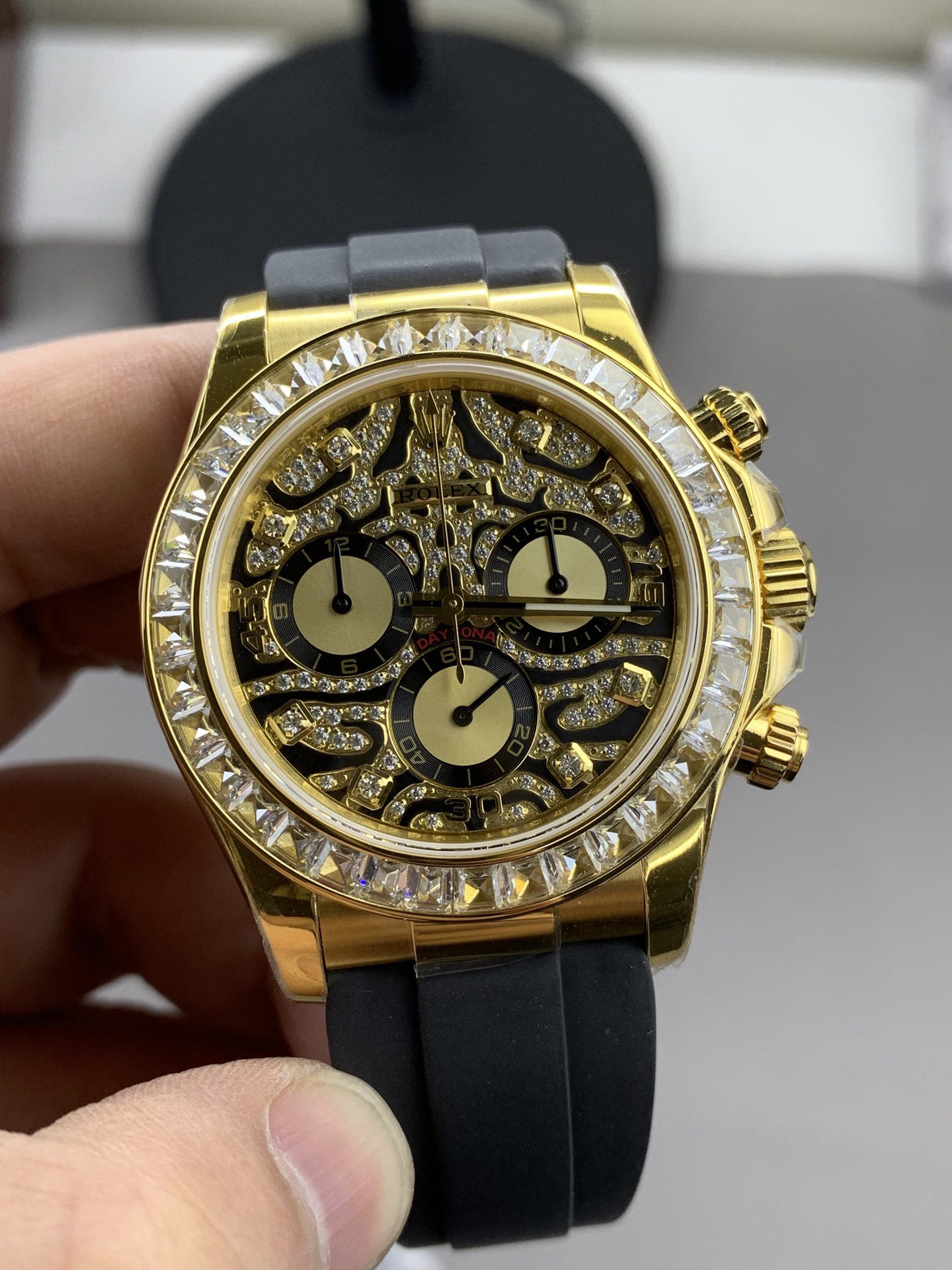
A visual representation of high-end gold finishing and the hidden 4130 power.
Two Common Misconceptions That Cost Buyers Real Money
I have seen too many first-time buyers fall for these two myths, and they usually end up returning the watch or selling it at a loss.
Misconception 1: “The movement is hidden, so I don’t need to care about it.”
This is the most dangerous assumption. The movement is hidden behind a solid caseback, but its performance is not hidden. The rotor creates a noise that you hear on your wrist. The winding efficiency determines whether you need to wind the watch every morning. The chronograph pushers are physically connected to your fingers. In my experience, buyers who ignore the movement often end up with a watch that stops after 36 hours, or a chronograph hand that drifts off zero after every use. The so-what here is devastating: a bad movement ruins the entire ownership experience. You will not enjoy a watch that stops randomly or has a loose rotor. You will wear it once, and then it will sit in a drawer. If you are going to buy a high-end replica rolex, you must prioritize the movement over the dial colour or the bracelet finish.
Misconception 2: “A 1:1 clone watch is bomb-proof and requires no maintenance.”
I have heard buyers say, “It is a clone, so it should work forever.” That is simply not true. The 4130 clone is a complex mechanical system with over 200 components. It has a vertical clutch, a column wheel, and a chronograph assembly that relies on delicate springs and levers. From what I have seen, the average lifespan of a well-cared-for 4130 clone is about 2 to 3 years of daily wear before it needs an oiling and regulation service. If you use the chronograph function extensively (more than 5 times a day), that lifespan drops to 1.5 years. The reason is that the clone movements are assembled in large batches, and the lubrication is not as precise as the genuine Swiss oils. The gears will start to drag, and the amplitude will drop. The actual impact of this misconception is that buyers ignore early warning signs – like a slightly slower seconds hand or a chronograph that resets to the 12 o’clock mark but is 0.5 seconds off. By the time they notice, the movement has already worn out the pinions, and the repair cost is often higher than buying a new movement.
To avoid these issues, you must treat the 4130 clone like a real mechanical watch. Do not use the chronograph as a stopwatch every day. Let the movement run continuously to keep the oils fluid. And if you notice any irregularity, get it serviced by a specialist who works on these clones – do not take it to a generic watch repair shop.
Wrist Test vs Macro Test – The Ultimate Reality Check
This is a unique analysis that most reviews skip entirely, and it has saved me from making a few bad purchases. The watch community loves macro photography. You see high-resolution shots of the movement, the laser engraving, and the alignment of the indices. These macro shots are great for showing the fine details, but they are actually misleading for the average buyer. The real test of a quality replica watch is the wrist test, not the macro test.
The Macro Test: This is what you see on forums and YouTube. A reviewer puts the watch under a 40x microscope, compares the depth of the engraved text, and checks the exact angle of the lug finishing. From a macro perspective, the best 1:1 clone watches are almost perfect. You can see the correct thickness of the ceramic bezel lettering and the precise bevel on the case lugs. However, the macro test completely ignores the dynamic behaviour of the movement. A watch can have perfect engravings and still have a rotor that scrapes the caseback, or a date change that takes three hours to complete.
The Wrist Test: This is what I do before I recommend any watch to a friend. I wear it for three days without looking at it under any magnification. Here is what I look for: the sound of the rotor when I shake my wrist – does it spin smoothly, or does it rattle like a tin can? The winding torque – does the crown feel gritty or buttery when I manually wind it? The chronograph response – when I press the pusher, does the hand start instantly without the “jump” that cheap clones have? The power reserve over a weekend – can I leave it unwound on Friday and still have it running on Monday morning?
In my experience, a watch that passes the wrist test will give you 90% of the genuine ownership experience. A watch that only passes the macro test but fails the wrist test is a glorified paperweight. I have seen buyers obsess over a 0.1mm difference in the bezel font, only to receive a watch that runs 20 seconds fast per day and stops when they activate the chronograph. The so-what is that you should not rely solely on high-definition photos. When you are buying a replica rolex direct buy, ask the seller for a video of the movement running, specifically showing the chronograph start and reset. If the watch does not reset to zero instantly or if the seconds hand hesitates on start, do not buy it, regardless of how perfect the macro photos look.
Based on Experience – My Honest Advice Before You Click Buy
I have been through this process enough times to know exactly what questions you should ask and what you should expect. Here is my straightforward advice.
First, confirm the movement source explicitly. Do not ask “Is this a good replica?” Ask “Is this the Dandong 4130, and is it from Clean or VS?” The seller should be able to answer that clearly. If they give you vague responses, that is a red flag.
Second, set your expectations about accuracy. The 4130 clone runs at 28,800 bph, which is the same as the genuine. In my experience, out of the box, it will run between +8 and +15 seconds per day. A good watchmaker can regulate this down to +3 or +4 seconds, but do not expect chronometer certification. The good news is that the 4130 is very stable – it does not gain 20 seconds one day and lose 10 seconds the next. It is consistent, which is what matters for daily use.
Third, do not use the chronograph for the first 100 hours of wear. This sounds counterintuitive, but the clone movement needs a break-in period. The oils need to spread across the gear teeth. If you start the chronograph immediately, you put extra stress on the vertical clutch before it is properly lubricated. Give the watch three days of normal timekeeping, and then start using the chronograph. I learned this the hard way – I had a VS version that developed a sticky reset issue because I used the chronograph on the first day. After letting it run normally for a week, the issue resolved itself.
Fourth, consider the source carefully. I have purchased from multiple dealers, and I have had consistently good experiences with https://www.rolexreplicas.us.com/. They are straightforward about the movement sources and they do not swap 7750 movements into 4130 cases. I have also had positive results with replicafactory.cx, which is a trusted name in the community. My advice is to stick with dealers who are transparent about the factory, rather than dealers who list everything as “super clone” without details.
Finally, understand that the 4130 clone is not a cheap movement. It adds about $150 to $200 to the cost of the watch compared to a 7750 version. Is that premium worth it? In my experience, absolutely. The 7750 version feels like a toy. The 4130 clone feels like a real machine. The price difference is less than the cost of a single dinner at a nice restaurant, but it changes your daily enjoyment of the watch completely.
Frequently Asked Questions
With normal daily wear and moderate chronograph use, you should expect 2 to 3 years before the amplitude drops noticeably. If you wear it only occasionally, it can last 4 years. After that, it will need a cleaning and re-oiling, which costs around $80 to $120 from a specialist.
Yes, but not by a standard watchmaker. You need a repairer who specifically works on Dandong movements. The good news is that spare parts are readily available. You can buy a complete replacement Dandong 4130 movement for about $200, so instead of repairing a broken chronograph spring, many people just swap the entire movement.
In practice, no. The genuine Rolex 4130 will run for about 70 hours. The clone runs for 65 to 68 hours. This is still more than enough for a weekend, but do not expect the full 72 hours. If your watch consistently stops after 50 hours, that indicates a problem with the mainspring or the rotor winding efficiency.
This is a tricky one. The 4130 clone is not waterproof from the factory. The gaskets are often poor quality. If you want water resistance, you must ask the seller specifically to pressure test the watch before shipping. Even then, I would not recommend swimming with it. Light rain and hand washing are fine, but submerging it is a risk.
The easiest way is to look at the rotor. The 7750 rotor is thick and heavy, and it has a distinct, loud wobble when you spin it. The 4130 rotor is thinner and spins very smoothly with a subtle hum. Also, the chronograph pushers on the 7750 require more force to press, while the 4130 pushers are light and crisp.
If you value power reserve and stability, yes. The Clean Factory version consistently gives me more predictable timekeeping. If you prefer a smoother winding feel and do not mind winding the watch every 60 hours, the VS version is fine. I personally recommend Clean for a daily driver.
Yes, partly. The genuine balance wheel and the genuine mainspring can be installed. However, the automatic winding bridge and the chronograph layers are not interchangeable without custom fitting. Most people only swap the balance wheel for better regulation, not the entire movement.
The biggest risk is not the movement itself, but the shipping damage. The 4130 clone is a delicate mechanism. If the package is dropped heavily, the rotor screw can loosen, causing the rotor to scrape the caseback. Always ask the seller to double-wrap the watch and to secure the rotor with a piece of tape during shipping. Remove the tape yourself when it arrives.

